
Real Analysis: Continuity
Continuity and Connectedness
Continuity Preserves Connectedness
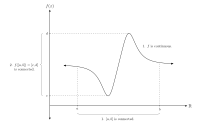
Continuous functions preserve connectedness. Consider the function $f : (X, d_X) \rightarrow (Y, d_Y).$ If $S$ is a connected subset of $X,$ then $f(S)$ is a connected subset of $Y.$ The geometric intuition behind this theorem is straightforward - a continuous function has no holes or gaps in it, and so if its domain has no holes or gaps in it, then so too should its image set. Note that the converse of the theorem is false - a connected image set does not imply a connected domain, even for continuous functions.
Intermediate Value Theorem
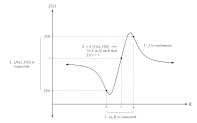
Perhaps the most important consequence of the above theorem is the intermediate value theorem. The intermediate value theorem states that if a real function $f$ is defined over an interval $[a, b],$ then for every $r$ in the interval $[f(a), f(b)],$ there exists a $c \in [a, b]$ such that $f(c) = r.$
Problems
Continuity preserves connectedness: Show that if $f : (X, d_X) \rightarrow (Y, d_Y)$ is continuous and $S$ is a connected subset of $X,$ then $f(S)$ is connected.
To show that $f(S)$ is connected, we must show that it is not the union of two disjoint nonempty subset of $f(S).$ Assume to the contrary that it is. Call these sets $A$ and $B.$ Because $f$ is continuous, it follows that $f^{-1}(A)$ and $f^{-1}(B)$ are open in $S.$ Because preimages preserve unions, we see that $f^{-1}(A) \cup f^{-1}(B) = f^{-1}(A \cup B),$ and so $f^{-1}(A) \cup f^{-1}(B) = S.$ But this is a contradiction, since this implies that $S$ is disconnected. Therefore $f(S)$ was connected after all.
Intermediate Value Theorem: Show that if $f$ is a continuous real function on $[a, b]$ where $f(a) \leq f(b),$ then for each $r$ in the interval $[f(a), f(b)]$ there exists a $c \in [a, b]$ such that $f(c) = r.$
Note that $[a, b]$ is connected. Because $f$ is continuous, it follows that $f([a, b])$ is connected. Therefore $f([a, b])$ is either a singleton, an interval, or all of $\mathbb{R}.$
If $f([a, b]) = \{p\},$ then $f(c) = p$ for all $c \in [a, b].$
If instead $f([a, b]) = \mathbb{R},$ then this is in fact a contradiction, since it implies that $\mathbb{R}$ is compact, which it is not.
If in the last case $f([a, b])$ is an interval, then because $f(a), f(b) \in f([a, b]),$ it follows that $[f(a), f(b)] \subseteq f([a, b]).$ Thus, if $r \in [f(a), f(b)],$ it follows that $r \in f([a, b]),$ so there exists a $c \in [a, b]$ such that $f(c) = r.$
Provide an example of a continuous function with a disconnected domain and a connected image set.
Consider the piecewise function $f : [1, 2] \cup [3, 4] \rightarrow [1, 2]$ where
$$f(x) = \left\{\begin{array}{ll} x & \text{ when } x \in [1, 2]\\x-2 & \text{ when } x \in [3, 4]\end{array}\right.$$
We can see that $f$ is continuous and $[1, 2]$ is connected but $[1, 2] \cup [3, 4]$ is disconnected.
No sign changes between zeroes: Let $f$ be a continuous, connected real function defined on the interval $[a, b]$ with a finite number of zeroes $\{k_1, \ldots, k_n\},$ where $k_1 < k_2 < \ldots < k_n.$ Show that either $f(x) > 0$ for all $x \in (k_i, k_{i+1})$ or $f(x) < 0$ for all $x \in (k_i, k_{i+1})$ for all $i \in 1, \ldots, n-1.$
Show that this property holds for the regions $[a, k_1)$ and $(k_n, b]$ as well.
Proof by contradiction.
Assume there are two points $x_1, x_2 \in (k_i, k_{i+1})$ such that $f(x_1) > 0$ and $f(x_2) < 0.$ Assume $x_1 < x_2.$ By the intermediate value theorem, there exists a point $x_3 \in (x_1, x_2)$ such that $f(x_3) = 0.$ But this is a contradiction, since there is no zero between $k_i$ and $k_{i+1}.$ Therefore $f(x_1)$ and $f(x_2)$ had the same sign after all. The same logic applies if $x_2 < x_1.$
If $a=0$ then the above logic applies to the regions $(a, k_1).$ If $f(a) > 0,$ then assume there is an $x_1 \in (a, k_1)$ such that $x_1 < 0.$ Then the intermediate value says there is a value $x_2 \in (a, x_1)$ such that $f(x_2) = 0.$ But this contradicts the fact that $k_1$ is the least zero if $f.$ Therefore $f(x) > 0$ for all $x \in [a, k_1)$ after all. If instead $f(a) < 0,$ then the same logic assures that $f(x) < 0$ for all $x \in [a, k_1).$
The logic for $a$ and the region $[a, k_1)$ holds mutatis mutandis for $b$ and the region $[k_n, b).$