
Real Analysis: Derivatives
Derivative Tests
Motivation: Finding Extrema
Many problems in both pure and applied math are answered by finding the maximum or minimum values of functions. Derivative tests allow us to find such extrema for differentiable functions. Though there are several variations, each essentially proceeds by first finding the zeroes and critical points of a function, then analyzing various derivatives at them and the region around them to determine whether they are extrema. After that, the list of eligible points can be analyzed further for the global maximum and minimum values, should they exist.
First Derivative Test
The first derivative test establishes whether a critical point is a local minimum or a local maximum. Let $f$ be a real function with a critical point at $c,$ and let there be some $r \in \mathbb{R}^+$ such that $f$ is continuous at $c$ and differentiable on $(c - r, c)$ and $(c, c + r).$ The first derivative test sets up four possibilities:
-
If $f' \leq 0$ in $(c - r, c)$ and $f' \geq 0$ in $(c, c + r),$ then $c$ is a local minimum of $f.$
-
If $f' \geq 0$ in $(c - r, c)$ and $f' \leq 0$ in $(c, c + r),$ then $c$ is a local maximum of $f.$
-
If $f' \leq 0$ in both $(c - r, c)$ and $(c, c + r)$ or $f' \geq 0$ in both $(c - r, c)$ and $(c, c + r),$ then $c$ is not an extremum of $f.$
-
If any other outcome prevails, then the test provides no information about the existence of an extremum at $c.$
The first derivative test thus requires finding the critical points of a function, then establishing a region on each side of each critical point where the derivative is of constant sign, and then using the sign to determine whether the critical point is a maximum or a minimum.
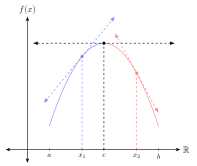
The strength of the first derivative test lies in the fact that it can detect extrema at points where the first derivative isn't defined, such as at cusps or sharp angles. The price of this is the need to both find the two regions around the critical point where sign of the derivative is uniform or zero, then test two points within the regions to determine the sign. This process can be somewhat tedious.
The he good news is that if both the first and second derivatives are defined at a critical point, then we don't have to live like this. To relieve us of such tedium, we develop the second derivative test, which lets us use the concavity of a critical point to determine whether it is a maximum or a minimum.
Second Derivative Test
For a differentiable real function $f,$ the second derivative test states that if $f'(c)=0$ and $f''(c) > 0,$ then $f(c)$ is a local minimum, and likewise that if $f'(c)=0$ and $f''(c) < 0,$ then $f(c)$ is a local maximum. The second derivative test is capable of finding many extrema, especially for simple functions like polynomials and rational functions. However, we must note that its converse is not true - it does not state that extrema must have zero first derivative and nonzero second derivative. For example, the absolute value function $f(x) = |x|$ has its global minimum at $x = 0,$ while its first derivative is undefined in precisely that location.
Problems
Show that if $f$ is continuous on $[a, b]$ and monotonically decreasing on $(a, b),$ then $f$ is monotonically decreasing on $[a, b]$ and $f(a) = \sup\limits_{[a,b]} f$ and $f(b) = \inf\limits_{[a, b]} f.$
We show first that $f(a)$ is an upper bound for $f$ on $[a, b),$ then show that it is the least upper bound.
Proof by contradiction. Assume $f(a) < f(c)$ for some $c \in (a, b).$ Then $f(c) - f(a) = p > 0.$ Pick $\varepsilon = p.$ Because $f$ is continuous on $[a, b],$ there exists a $\delta > 0$ such that $|f(x) - f(a)| < p$ whenever $x - a < \delta.$ Pick $\delta_0 = \min\{\delta, \frac{c-a}{2}\}.$ Then $a < x < a + \delta_0 < c,$ and so because $f$ is monotonically decreasing, $f(x) \geq f(c).$ Therefore $|f(x) - f(a)| = f(x) - f(a) \geq f(c) - f(a) = p.$ But $f(x) - f(a) < p,$ which is a contradiction. Therefore $f(a)$ is an upper bound for $f$ on $[a, b)$ after all.
Next, assume that there exists some $c \in \mathbb{R}$ such that $c < f(a)$ and $c = \sup\limits_{[a, b)}f.$ Then $f(a) - c = p > 0.$ Pick $\varepsilon = p.$ Then there exists some $\delta > 0$ such that $|f(a) - f(x)| < p$ whenever $x - a < \delta.$ Because $f(a)$ is an upper bound for $f$ on $[a, b),$ we see that $|f(a) - f(x)| = f(a) - f(x) < p.$ But this implies that $c < f(x),$ which is a contradiction. Therefore $f(a) = \sup\limits_{[a, b)} f$ after all. It follows that $f$ is monotonically decreasing on $[a, b).$
The same logic shows that $f(b)$ is the infimum of $f$ on $[a, b].$ This in turn makes $f(a)$ the supremum of $f$ on $[a, b].$ Thus $f$ is monotonically decreasing on $[a, b].$
Show that if $f$ is continuous on $[a, b]$ and monotonically increasing on $(a, b),$ then $f$ is monotonically decreasing on $[a, b]$ and $f(a) = \inf\limits_{[a,b]} f$ and $f(b) = \sup\limits_{[a, b]} f.$
We show first that $f(a)$ is a lower bound for $f$ on $[a, b),$ then show that it is the greatest lower bound.
Proof by contradiction. Assume $f(a) > f(c)$ for some $c \in (a, b).$ Then $f(a) - f(c) = p > 0.$ Pick $\varepsilon = p.$ Because $f$ is continuous on $[a, b],$ there exists a $\delta > 0$ such that $|f(x) - f(a)| < p$ whenever $x - a < \delta.$ Pick $\delta_0 = \min\{\delta, \frac{c-a}{2}\}.$ Then $a < x < a + \delta_0 < c,$ and so because $f$ is monotonically decreasing, $f(x) \leq f(c).$ Therefore $|f(x) - f(a)| = f(a) - f(x) \geq f(a) - f(c) = p.$ But $f(a) - f(x) < p,$ which is a contradiction. Therefore $f(a)$ is a lower bound for $f$ on $[a, b)$ after all.
Next, assume that there exists some $c \in \mathbb{R}$ such that $c > f(a)$ and $c = \inf\limits_{[a, b)}f.$ Then $c - f(a) = p > 0.$ Pick $\varepsilon = p.$ Then there exists some $\delta > 0$ such that $|f(a) - f(x)| < p$ whenever $x - a < \delta.$ Because $f(a)$ is an upper bound for $f$ on $[a, b),$ we see that $|f(a) - f(x)| = f(x) - f(a) < p.$ But this implies that $c > f(x),$ which is a contradiction. Therefore $f(a) = \inf\limits_{[a, b)} f$ after all. It follows that $f$ is monotonically increasing on $[a, b).$
The same logic shows that $f(b)$ is the supremum of $f$ on $[a, b].$ This in turn makes $f(a)$ the infimum of $f$ on $[a, b].$ Thus $f$ is monotonically increasing on $[a, b].$
First derivative test - Part I: Show that if $f$ is continuous on $(c - r, c + r),$ $f' \leq 0$ on $(c - r, c),$ and $f' \geq 0$ on $(c, c + r),$ then $c$ is a local minimum of $f.$
Since $f'$ is negative on $(c - r, c),$ it follows that $f$ is decreasing on $(c - r, c).$ Because $f$ is continuous at $c,$ it follows that $f(c) = \inf\limits_{(c-r, c]} f.$ Likewise, since $f'$ is positive on $(c, c + r),$ it follows that $f$ is increasing on $(c, c + r).$ Because $f$ is continuous at $c,$ it follows that $f(c) = \inf\limits_{[c,c+r)}f.$ Therefore $f(c)$ is a local minimum on $(c - r, c + r).$
First derivative test - Part II: Show that if $f$ is continuous on $(c - r, c + r),$ $f' \geq 0$ on $(c - r, c),$ and $f' \leq 0$ on $(c, c + r),$ then $c$ is a local maximum of $f.$
Since $f'$ is positive on $(c - r, c),$ it follows that $f$ is increasing on $(c - r, c).$ Because $f$ is continuous, it follows that $f(c) = \sup\limits_{(c-r,c]} f.$ Likewise, since $f'$ is negative on $(c, c + r),$ it follows that $f$ is decreasing on $(c, c + r).$ Because $f$ is continuous at $c,$ it follows that $f(c) = \sup\limits_{[c,c+r)} f.$ Therefore $f(c)$ is a local maximum on $(c - r, c + r).$
Second derivative test: Show that if $f'(c) = 0$ and $f''(c) > 0,$ then $f(c)$ is a local minimum.
Since $f'(c) = 0,$ it follows that $c$ is a critical point of $f.$ Since $f'$ is defined at $c,$ it follows that $f$ is defined at $c.$
Since $f''(c) > 0,$ it follows that $\lim\limits_{x \rightarrow c}\dfrac{f'(x) - f'(c)}{x - c} > 0$ for some neighborhood $(a, b)$ around $c.$ Since $f'(c) = 0,$ we see that $f'(x) > x - c.$ Therefore $f'(x) < 0$ when $a < x < c$ and $f'(x) > 0$ when $c < x < b.$ This in turn implies that $f$ is decreasing on $(a, c)$ and increasing on $(c, b).$ It follows by the first derivative test that $c$ is a local minimum.
Second derivative test: Show that if $f'(c) = 0$ and $f''(c) < 0,$ then $f(c)$ is a local maximum.
Since $f'(c) = 0,$ it follows that $c$ is a critical point of $f.$ Since $f'$ is defined at $c,$ it follows that $f$ is defined at $c.$
Since $f''(c) < 0,$ it follows that $\lim\limits_{x \rightarrow c}\dfrac{f'(x) - f'(c)}{x - c} < 0$ for some neighborhood $(a, b)$ around $c.$ Since $f'(c) = 0,$ we see that $f'(x) < x - c.$ Therefore $f'(x) > 0$ when $a < x < c$ and $f'(x) < 0$ when $c < x < b.$ This in turn implies that $f$ is increasing on $(a, c)$ and decreasing on $(c, b).$ It follows by the first derivative test that $c$ is a local maximum.